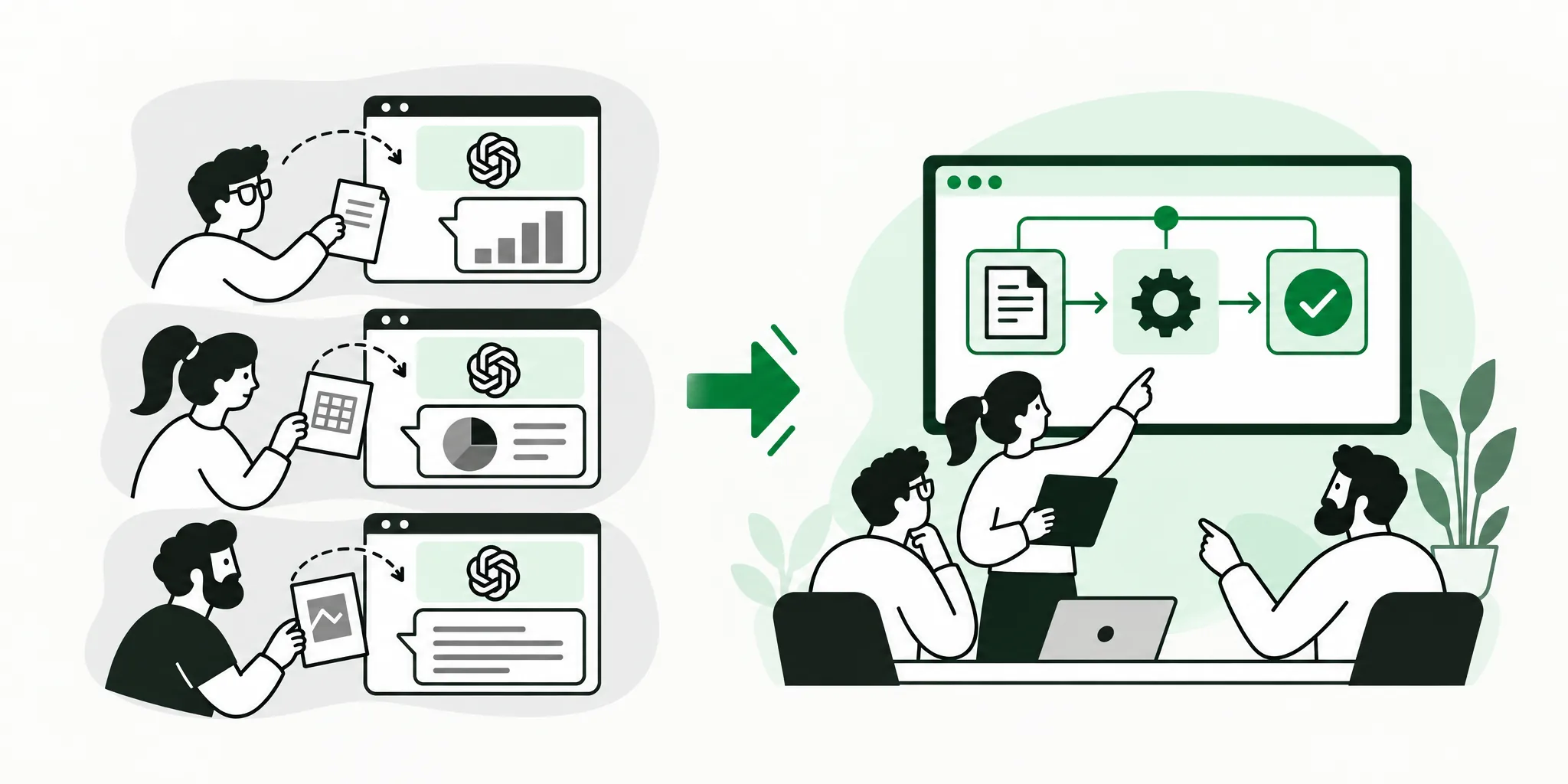
Somewhere in your operation, someone has probably already worked this out: collect a batch of documents, drop them into ChatGPT or Claude, type a prompt, get back a report. It works, and it's been working for months. It's tempting to think the next step is a custom app that does the same thing through a nicer interface.
It may not be. If the goal is just "upload a document, get a report," AI chat may already be the cheapest way to do that. The case for building something isn't cost. It's that right now the process lives in one person's prompt habits, not in your business.
| AI chat workflow | Custom application |
|---|---|
| User decides what prompt to use | Process is predefined |
| Every user does it slightly differently | One consistent workflow |
| Relies on the user's skill at prompting | Encodes the company's process |
| Files live in individual chats | Files and outputs belong to the company |
| Hard to trace what happened | Full audit trail |
| Report quality depends on the prompt | Standardised report structure |
| User manually checks and copies results | Subsequent steps can automate |
| Chat history is the record | Structured business data is the record |
| Hard to connect to other systems | Connects to ERP, CRM, email, databases |
| Usage and results aren't measurable | Activity, errors and outcomes are visible |
| The process lives in people's heads | The process is captured in software |
Standardisation is the strongest argument
"Upload five documents, ask AI to analyse them, generate a report" sounds simple, but five employees running that today will upload different files, phrase the prompt differently, ask different follow-ups, and produce reports in slightly different formats. A custom build turns that into one sequence: upload, validate, extract, analyse, cross-check, generate, review, approve, archive. The user no longer needs to know how to prompt the model.
With a custom application, your business keeps the knowledge
If one employee has quietly become excellent at prompting the model for these reports, that skill is attached to them. When they leave, it leaves too. Encode the process into software instead, and the prompt, business rules, report structure and validation logic stay put regardless of who's using the system.
"A used system with unoptimised workflows produces better outcomes than an optimised system nobody uses. The same logic applies here: an informal AI habit only one person can run isn't an asset the company can rely on."
Structured data is the real shift
A chat conversation produces a document. A system built around the same process can produce a document and structured data at the same time, such as a customer name, a project reference, an amount, a count of flagged issues, each as a field rather than a sentence. Fields can be searched, compared, aggregated, and fed into a dashboard, an ERP, or a CRM. A paragraph in a chat response can't. This is usually the point a project stops being "an AI report generator" and becomes workflow automation.
Review goes where it's needed
Chat workflows have one review step: the employee reads the output and decides whether to trust it. A system built around the process can flag only what needs a look, such as an amount that differs between two source documents or a delivery date that wasn't found, so the employee reviews three flagged items instead of re-reading the whole report.
When AI chat is still the right answer
If all you need is for one person to upload a document now and then, keep using ChatGPT or Claude directly. It's probably the most economical option, and software built around an occasional task won't pay for itself.
Building makes sense once the task has become a repeatable process. That usually means most of these are true:
- Several people do it, or it happens every week.
- Results need to be consistent regardless of who produces them.
- You need a record of what was uploaded, what came out, and who approved it.
- The output has to feed another system, such as your ERP, CRM, or reporting.
At that point you aren't buying "an AI application that writes reports." Your team is already getting value from AI, one chat at a time. What you'd be investing in is taking that process out of individual conversations and turning it into a workflow your business owns. It's the same reasoning behind replacing legacy systems with software built around how the operation actually works, applied to a workflow your team built for itself.
To see the same shift in practice, this maintenance intake case study shows what changed when ad hoc AI-assisted reporting became a system the whole team ran through.